Sunday, April 9, 2017

Design Thinking, Literature & First Grade Part 3

First Grade Fairy Tale Design Thinking Project: Prototype & Share Out

First grade students moved into the final step of this multi-month project with the prototype and share out stage of the design thinking process. During the previous step, Ideate, students worked in their small groups to come up with different solutions for the problem that they had decided to focus on. Students then determined what was the solution that they were going to focus on or combine their different ideas into one idea. Next first graders started building and creating their prototypes. For prototyping students had access to lots of different materials from cardboard and construction paper to pipe cleaners and playdoh. Student worked in their groups using their collaborator quality norms to make sure everyone was working together and had a voice in the prototyping.


As an added element to the prototyping stage the students were able to design and print an element of their prototype with the library’s 3D printers. First graders had been asking to be able to print something with the library’s printers and this was a perfect opportunity for students to learn how to use Tinkercad, a 3D printing software, and make a 3D object that was connected to a project they were working on. Students collaborated with their groups to decide what each of them was going to design and print that would fit into their prototype. First graders were introduced to the Tinkercad program with a short tutorial on how to 3D design using different shapes. Then they dived into the program figuring out how to manipulate the shapes to create the object. First graders did a great job designing, reworking and rethinking their ideas to create an object for their prototype.


The final step in the project was for the whole first grade to come together and share their prototypes. An all grade share out was hosted in the library where students were able to share their prototypes and see the work of their classmates. Students created signs that explained what the problem was they were trying to solve and a brief description of their prototype. Students were excited to not only share their solutions but see the problems that classmates in other classes worked on see the solutions that were developed. A final reflection was held were first graders shared what they noticed about the prototypes and the whole design thinking process they had engaged in.


This project has become one of my favorites. Students become so engaged in this process. They are excited to dive into different versions of stories and are always making observations that are new each year. The connection to literature is something that my classroom teachers really love about this work and notice the benefits that this project has on their reading and writing work in the classroom. First graders are so engaged in the building process, they are self-reliant and collaborative as they turn their ideas into prototypes. Students are so willing to take their ideas and redesign and rework their plans to create a prototype. First graders are so invested in the idea of creating a solution that will help someone else. I am hoping that I can continue to build on this work with these students as they advance through the grades and continue to engage them in fictional and real world issues using the design thinking process.

Wednesday, April 5, 2017

Design Thinking, Literature & First Grade Part 2

First Grade Fairy Tale Design Thinking: Define and Ideate


My first grade students had spent several weeks diving into fairy tales. Students studied several different versions of the stories to gain as much empathy and understanding about the characters and the elements of the stories. We document all of our thoughts and thinking on a large board throughout the process. The next step was to take some time to look at our thinking and recalling different elements of the stories to define the issues that the characters were dealing with so they could design a solution.


Students spent time talking through and organizing our notes and thinking to better define the challenges of the characters. Students worked in small groups and we talked about it and sorted the ideas into different categories to help better narrow down the challenges. For the different stories the students noticed and defined many different challenges.


Students in the Goldilocks and the Three Bears group defined the challenges as entertainment, security and manners. Students felt that if Goldilocks has more things to do she would not have broken into the three bear’s house. They also felt if the three bear’s had better security at their house then Goldilocks would not have been able to break into the house. The final challenge that the students identified was manners, they felt that if Goldilocks and the three bears had better manners then they would all have been able to be friends.


The Three Little Pigs class defined three challenges that the characters faced including manners, a food source for the wolf, and security for the pigs. Students felt that if the pigs and wolf had better manners they would have been able to be friends. First graders defined access to food as an issue they believed that the wolf had a right to eat food and if he had an alternative food source then the wolf and the pigs could live in harmony. The final challenge the students defined was security for the pigs, students felt that if the pigs had been security at their houses they would be protected from the wolf.


First graders in the Little Red Riding Hood group defined five challenges for the characters including a safer route for Little Red, an alternative food source for the wolf, friendship and community for Little Red, meditation for the wolf and the wolf and Little Red needed better listening skills. Students felt that Little Red needed a safer route to get from her house to grandma’s house. They also decided that if the wolf had another food source he would leave Little Red alone. They also decided the if Little Red and the wolf had a chance to be friends and live in the community together they could live in peace. Students also felt that if the wolf was calmer and practiced meditation he would not try to eat Little Red and her grandmother. Finally they felt that Little Red needed to work on her listening skills because if she had listened to her mother and stayed on the path she would have arrived at grandma’s house safely.


The next stage was the Ideate step. Students were organized in small groups and picked a challenge that they wanted to focus on to solve. Students were reminded of our collaborator qualities that we defined at the beginning of the school year so that they would work as a team. First graders were given time to sketch out, draw, and write out ideas to solve their challenge. The next step was for students to share out their ideas with their group, talk about their plans, merge their ideas and find a solution to focus on as a group.


First graders did a wonderful, focused job defining the challenges that the characters were facing in the stories. Students recalled details from all the different versions of the stories that we read and were thoughtful about defining and determining the challenges that the characters faced based on their understandings. They did a great job ideating their solutions and working as collaborators to combine their ideas to focus on one solution to prototype.

Next step; Prototyping!

Monday, March 27, 2017

Design Thinking, Literature & First Grade Part 1

I have tried to incorporate the design thinking process into my work in the library with my students as a vehicle for them to dive deeper into literature as well as embark on a collaborative design process. This year with my first grade students each of my three class tackled a different fairy tale to explore. One class looked at Goldilocks and the Three Bears, another explored The Three Little Pigs and the final group looked at Little Red Riding Hood.


We started the design thinking step of empathy by exploring different versions of the stories to help students better understanding the elements of the story and the issues that the characters were dealing with. Students spent time reading different versions of the books and talking about what were the main elements of the book including characters, setting, problem and solution. We compared and contrasted the different stories, each week students recalled and retold the version of the story they had heard the week before and then compared and contrasted and tracked the different elements of the stories.

As a continuation of the empathy stage, students focused on the setting and how that affects the elements of the story and the lives of the characters. Students worked in small groups to thinking deeper about how changing the setting would change the characters, materials, problem and solution in the stories. Groups were assigned different settings including space, a desert, mountains and a city. Students drew pictures and mapped out the new stories based on the change in setting. In addition to helping students develop a deeper empathy for the characters so they could better define their challenges this step helped them develop a deeper understanding of the elements of the story and how they are all connected.


For the final step in the empathy and understanding stage we focused on reading version of the story that highlighted the personality traits of the characters. This was a way to not only better understand and empathize with the characters so students could define and design a solution but to also highlight the elements of characterization in the books. After the reading students brainstormed and shared words that would describe the personalities of the main characters and how that helped or hindered their ability to solve the problem in the story.

Throughout this first process all of our notes, brainstorming and illustrations were documented on our share out board so that students could revisit, reference and recall important elements from different stories, brainstorming sessions and discussions.


Next: Define and Ideate!

Monday, February 20, 2017

The Brooklyn Bridge: Literature, Research and Collaboration

Over the course of several weeks the second grade classes embarked on a design project inspired by the studies they had been doing in their classes about the late-1800s and the book Twenty-One Elephants and Still Standing by April Jones Prince. In their classrooms students were spending time learning about the different aspects of life in the late 1800s including innovations, social justice and literature. In the library we read the book Twenty-One Elephants and Still Standing about the building of the Brooklyn Bridge. The book shares the story of the bridge and the fear people had at the time of the suspension bridge. PT Barnum, the great showman, arranged a stunt to prove the bridge was sturdy. He walked 21 elephants from his circus show across the bridge from Manhattan to Brooklyn to prove to people that the bridge was safe. Students read the story and reflected on what they learned about the bridge and connections to what they had learned about that time period.


Next, students engaged in the See/Think/Wonder thinking routine (Project Zero Making Thinking Visible: Thinking Routines https://tinyurl.com/l7kwhbm). As a class, students shared what they saw in the book including pictures and the story, what they thought about what they saw in the book and what they wondered about. The next step was to look at archived images from the New York Public Library Digital Collections. The pictures and drawings were from the building of the bridge. The images were posted around the library. Students spent time in small groups looking at each of the images and using the See/Think/Wonder thinking routine. The wonder questions from both of these thinking routine sessions became the foundation for our research into how the Brooklyn Bridge was built and how suspension bridges work.


The next step was to learn more about the building of the Brooklyn Bridge. Students learned about how the bridge was built on caissons. We learned about how the workers went into the caissons to level out the mud. They also learned about how many workers became sick with decompression sickness, including one of the engineers designing the bridge. Students learned that laws were passed after the building of the Brooklyn Bridge to protect the workers that were working in these dangerous conditions. Students all learned how the towers were built and the cables connected on the bridge to make the suspension bridge stable. We used Google Earth to explore the Brooklyn Bridge as well as the Golden Gate Bridge and noticed details of suspension bridges.


The final step was for students to work in small groups to design and built their own bridge inspired by what they learned about suspension bridges. They had to design bridges that could hold 21 small plastic elephants. Students were given a variety of materials to build with including cardboard, plastic cups, yarn, popsicle sticks, pipe cleaners and more. Students had to design, built, compromise with others, and rework/redesign to come up with a suspension bridge to hold the elephants. Students did a great job applying what they learned about the building of the Brooklyn Bridge and created new bridge designs. Student groups collaborated to design, prototype, test and rework their bridges designs throughout the project. They were creative with the use of the materials and how they utilized them to create their bridges.  With this project students continued to make connections with the literature they are reading, the history they are learning about as well developing their communication and collaboration skills!


Sunday, January 22, 2017

A Ruby Bridges Study: Empathy and Perspective with Pre-School Students

I have been thinking about what I can do in the library to help my students gain empathy and start to have an understanding and knowledge about social justice issues. I feel that I need to start sharing stories and events with my students at an younger age. I recently read an article about gaining empathy and perspective. These are skills that need to be nurtured in young students and even our youngest students can walk in another’s shoes. I decided to share the story of Ruby Bridges with my Junior Kindergarten students this past month. This fit with many of the discussions that the teachers were having with students in the classroom and was an opportunity to talk to students about injustice and how to stand up to it.

We started by reading the book The Story of Ruby Bridges  by Robert Coles. As we read the book we talked about what was happening in the story, including what segregation was and why it was unfair that people were treated differently by the color of their skin. We shared details about about Ruby Bridges’s real life and the fact that this is all a true story. We read the first half of the book and stopped on the page when Ruby was entering the school for the first time and white people were lined up yelling mean and ugly things at her, that US Marshals had to walk Ruby into the school to protect her and that many of the people in the crowd wanted to hurt her. We stopped the story there and students broke up into small groups with a teacher. We asked students to share what they thought Ruby was feeling at the moment. We asked students to put themselves in Ruby’s shoes and think about how they would feel if they were Ruby. Students shared that they would feel sad, lonely, scared, and angry. Some thought that she would want to run home, be with her mom and dad or go back to her old school where she was welcome. Others shared that maybe Ruby felt proud that she was helping bring about change and that she was brave.

The next week we finished the story and shared some of the historic details about Ruby’s life and what it was like after that first year of desegregation. Next we broke into small groups again with students and teachers and asked the students to think about what they would have done to stand up with Ruby Bridges. Students shared ideas like walking into school with her, holding her hand, telling the people that were being mean that they were wrong, telling people that everyone should be treated nicely, and being Ruby’s friend.

The final step of the project was to share a photo taken on Ruby’s first day of school that is part of the National Archives. We used the library’s green screen and the green screen app Do Ink to take a picture of each student standing in the historic picture with Ruby. Students then attached their picture to a poster sharing how they would stand up with Ruby Bridges. We shared these posters in a display in the library hallway and shared the students’ project at an all school assembly.


This project was really wonderful and showed me that even our youngest students have learn and have a conversation about topics of social justice. Students can gain empathy and understanding by reading books and talking about how the characters are feeling. I think as teachers in these difficult times it is more important than ever to help our student to gain empathy for others and be able to understand how someone else might be feeling and going through. I plan to do more projects like this in the future with not only my Junior Kindergarteners and my other students.

Thursday, December 15, 2016

Interactive Story Maps: Design, Maker & Legends with 3rd Grade Part 3

The final step of the Native American Interactive Story map project was for 3rd graders to share their final project. Student wanted to be able to share their maps with not only their classmates but with the whole third grade. We were able to find a shared time for the whole grade and they were able to share with everyone. The interactive story maps were setup around the library. Students connected their elements, started their maps up and then walked around to see their classmates creations.


Everyone did a wonderful job with this project. Students really embraced the idea of creating an interactive map for their Native American legends study. They worked at all the stages of this project from the summarizing, ideating and designing, testing and reworking to creating a final project. What was also wonderful was that some of the projects had some technical difficulties but the students embraced that as well. They figured out how to make the project work in a new way. The fact that the students were able to take their original idea and rethink it when it did not work to find a way to make it work was, I think, one of the best outcomes of the project. I also feel it was another example of how the maker culture and movement can fit with literature and literacy studies.


Sunday, December 4, 2016

Interactive Story Maps: Design, Maker & Legends with 3rd Grade Part 2

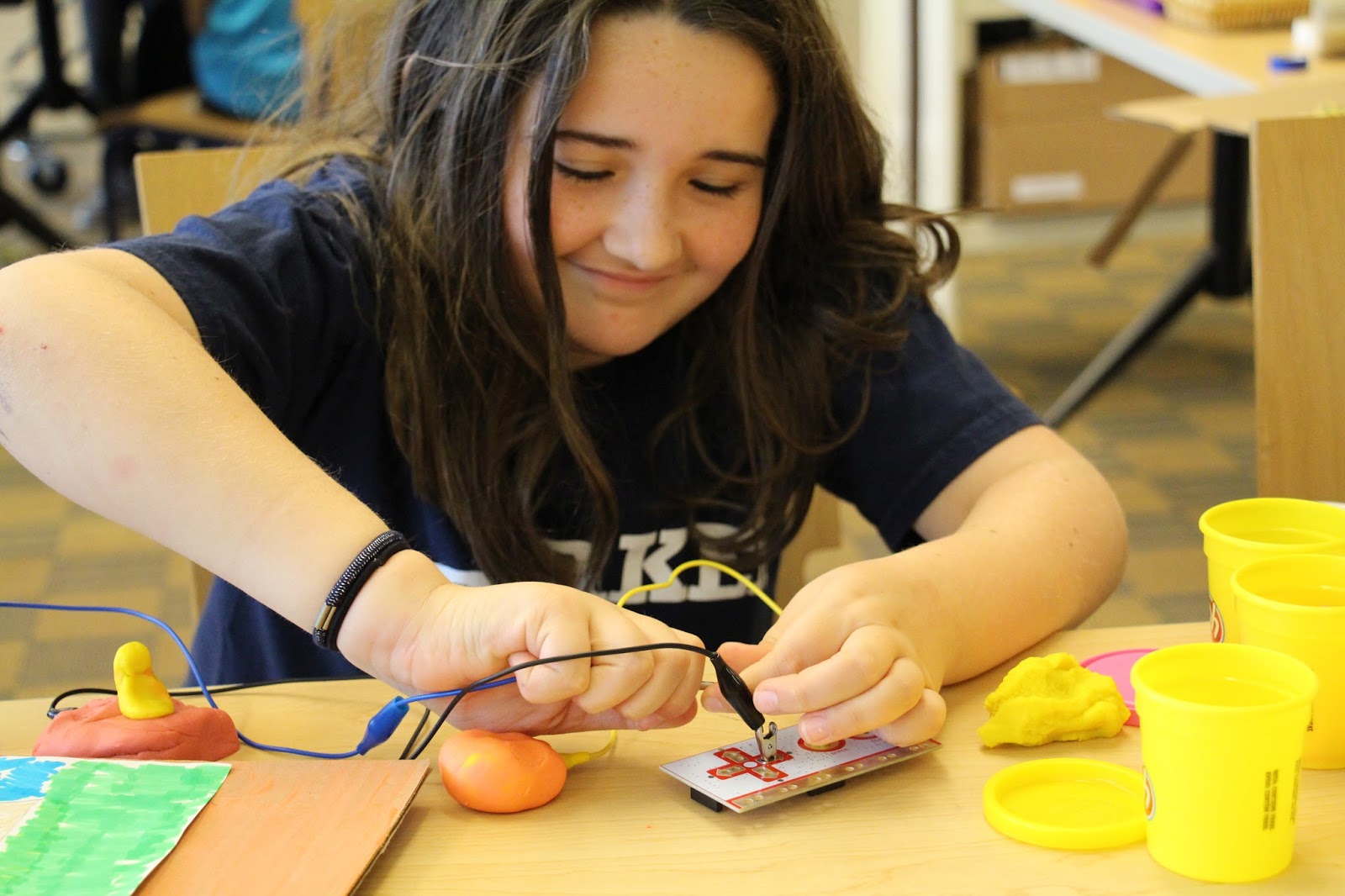
The next step of the process was to introduce the students to the elements they would be using to make their storyboards interactive. We started with having the different materials that would be available for them to play around with and try to become familiar with how they worked. The options were Makey Makey (http://www.makeymakey.com/) , LittleBits (http://littlebits.cc/), simple motors, and paper circuits (https://chibitronics.com/) and LED lights.  Makey Makey turns everyday objects into touchpads that students connected to sounds they recorded in Scratch. LittleBits are simple magnetic connective circuits. Paper circuits by Chibitronics are LED lights and copper tape that can be taped to cardboard and paper. The simple motors we purchased from Amazon with AAA battery packs. The petting zoo allowed students to walk around and play with the options and familiarize themselves with how they worked so when they moved to the planning stage they had a idea of how everything worked.


Then we assigned the students their interactive element. We assigned the elements for two reasons, one so that each story had four different interactive elements and second so that we would have enough of the materials to share across the grade.

Then the students did their planning. They designed what their storyboard would look like and how they would use their interactive element with their section of the legend. Students had to think about how the interactive element would highlight an important moment in their section of the story. They also planned out what materials they would use. Then they started making!


We spent 2-3 forty minute sessions building. In addition to the interactive elements students had paper, markers, cardboard, tape, playdough and more to build and create their interactive boards. Some of the student’s plans worked the first time. Some of the students needed to rethink and rework their original plans to make their boards work. Students were so engaged and so involved in the process. They were focused on their tasks and worked so hard to make their boards work. When they needed to rework their ideas that they were open to rethinking as well as receiving feedback from others on their ideas. Students were engaged and committed to figuring out what they needed to do. Those students that finished earlier went and helped other students who needed some assistance with their boards.


The final step will be our share out! The whole third grade will share their storyboards in a share out day. Students are so excited to share their boards with their grade mates as well as share their work.