Friday, November 19, 2021

Collaboration, Cooperation, Coding connected with Gaming

 A couple of years ago I came across this post by Colleen Graves on Instructables “Collaborative Makey Makey Sensory Maze.” It was such a cool project and it inspired me to make a collaborative Makey Makey maze for my kindergarten students for a solar system unit we were doing. I shared that project in a previous post: Coding, MakeyMakey and a Field Trip Around the Solar System. This project was so much fun to make and included the kindergarteners' voices and recordings with facts about what they learned about the different planets during our research but the coding and the building of the map was done by me and not by the students. I have always wanted to do a project where the students were the ones to code, design and build an interactive conductive board with Makey Makey, this year I had the chance with my fifth grade students.

For this project, fifth graders were challenged to work in collaborative groups and design, code and build cooperative, interactive video games. Students worked in design teams using different conductive materials and technology tools to create their interactive games.  Their game needed to be a cooperative game, two players that needed to work together to win the game.

The project started with introducing students, or reintroducing some students, to the Scratch coding program. Scratch is a free online coding program designed at MIT’s Media Lab. Scratch coding is a way for students to learn the coding language, as well as learning how to design, solve problems, iterate, share their work and amplify their voice.

Fifth graders explored the different code blocks, characters and background options. They also spent time playing games created with Scratch and shared to the Scratch site by students from around the world. This helped spark ideas about games that they could make themselves and allowed them to explore the code they would need to make their games. Scratch is a wonderful tool to use when integrating the Shared Foundation of Collaborate into the learning experience. When exploring the resources in Scratch “Learners participate in personal, social, and intellectual networks by: using a variety of communication tools and resources (Learner III.B.1) and establishing connections with other learners to build on their own prior knowledge and create new knowledge.” (Learner III.B.2) Fifth graders connected and explored the work of other learners from around the world on the Scratch Explore page, seeing what students were able to build and because Scratch is an open sourced coding platform, use some of the code that other students created. They also were able to build on the knowledge they had about coding, learn new coding techniques and build new code to share in the games.

Next students were put into their game building groups. Groups had a brainstorming session where they came up with ideas about what type of game they wanted to create; a maze, avoidance, where the players had to move to avoid an object, or a collect game, where players needed to collect objects in the game, or a combination of these different types of games. They also need a theme of the game and to design their game board. Then each group decided who would do each job in their game design and building. Some students focused on the coding, they would create and test all the code to make their game design work. Game board builders focused on wiring and building their interactive game boards using conductive materials and the Makey Makey. Finally the designer worked on the theme of their game, including background, characters, art and design of the game board. The group brainstorming and planning process focused on “Learners working productively with others to solve problems by: soliciting and responding to feedback from others” (Learner III.C.1). Fifth graders needed to listen to each other, give feedback and discuss options and come to a consensus on their game. They also needed to decide who was going to take on each of the roles to ensure that their games could be completed in the time allotted.


Now that each team had their design, theme, and plan set, they got to building their games! The coders worked on coding the games to work. When they were challenged with a code they couldn’t figure out how to execute, they talked with fellow classmates, searched the Scratch website for similar games to look at their code and searched Scratch message boards for advice. Through this iterative process, learners “actively contribute to group discussions” (Learner III.D.1) and fifth graders identify collaborative opportunities by: “deciding to solve problems informed by group interaction” (Learner III.A.3).

The game board designers worked with a variety of materials to make a large game board that would lay on the floor that players activated with their feet. They used conductive materials like copper sheets and conductive HVAC tape that were connected to wires that students cut and stripped and connected to a Makey Makey. A Makey Makey is an external plug and play circuit board that allows conductive materials to connect with a computer and coding that when triggered the circuit is completed and the code is triggered in the Scratch game. The game boards were triggered when the conducted materials were stepped on and connected to the instructions in the code. The game board designers tested and retested as they added the different layers of their game boards to ensure their buttons were working at each stage of the building process.


The designers were coordinating and working with each of the groups. They were working with the coders to find background images, characters, villains and objects for the players to collect in the game. They were also working with the game board builders to make sure the layout of the game boards worked and that the designs and illustrations added to the game boards fit with the theme of the game.

The fifth graders recognized throughout this process that they would not have been able to complete this on their own. They needed each other to share the building, coding and wiring. They also needed each other to talk through challenges and ideas as they were building their code, wiring and testing their boards and connecting all the pieces together to make a working interactive game board. Learners “recognized learning as a social responsibility” (Learner III.D.2).

After several sessions of building, coding, wiring, testing, editing and rethinking their game plans all their games were complete and it was time for game day share out! Each of the laptops with the Scratch program and game was projected onto one of the screens, connected their boards and students had a blast playing each others’ games!



Sunday, October 24, 2021

Books and 3D Printing: the Library Book Recommendation Vending Machine

 So much of the collaboration that I engage in is with co-teachers at my school or with and among my students but one of the best sources for sharing ideas and collaborating with fellow educators, for me, has been on social media, especially Twitter. I have followed so many great educators and creative people that also spark new ideas for books, projects, additions to the library space and more. I believe this is another way the “School library provides opportunities for school librarians to connect and work with the learning community by: Facilitating diverse social and intellectual learner networks” (School Library III.C.1). This summer I came across a post from a makerspace teacher that sparked an idea for a great start of the year book, design and technology project for my fourth graders, a toy vending machine!

I have followed @designmaketeach on twitter for years and have been inspired by a lot of the projects he does with his high school students in the school makerspace. Over the summer I came across this tweet:


I loved these machines as a kid! The excitement of twisting the dial to see what toy, stickers, or cool bouncing ball you would get. This sparked an idea, what if fourth graders designed small 3D prints that would go in the machine with a book review for our third graders. I decided to give it a try and have this be the first project of the school year for my fourth grade students. I was able to purchase the machine and the acorn containers that hold the small toys. I chose the machine that did not need a quarter or token to get a toy. We were all set to start the project.

Fourth graders started by thinking about a book that they loved to read in third grade and thought our current third graders would like too. Students shared with each other and talked about what books would be great recommendations for third graders. This process was a way for students to discuss books with each other and also think about what they would like to share with fellow learners. Students were “actively contributing to group discussions” (Learner III.D.1).

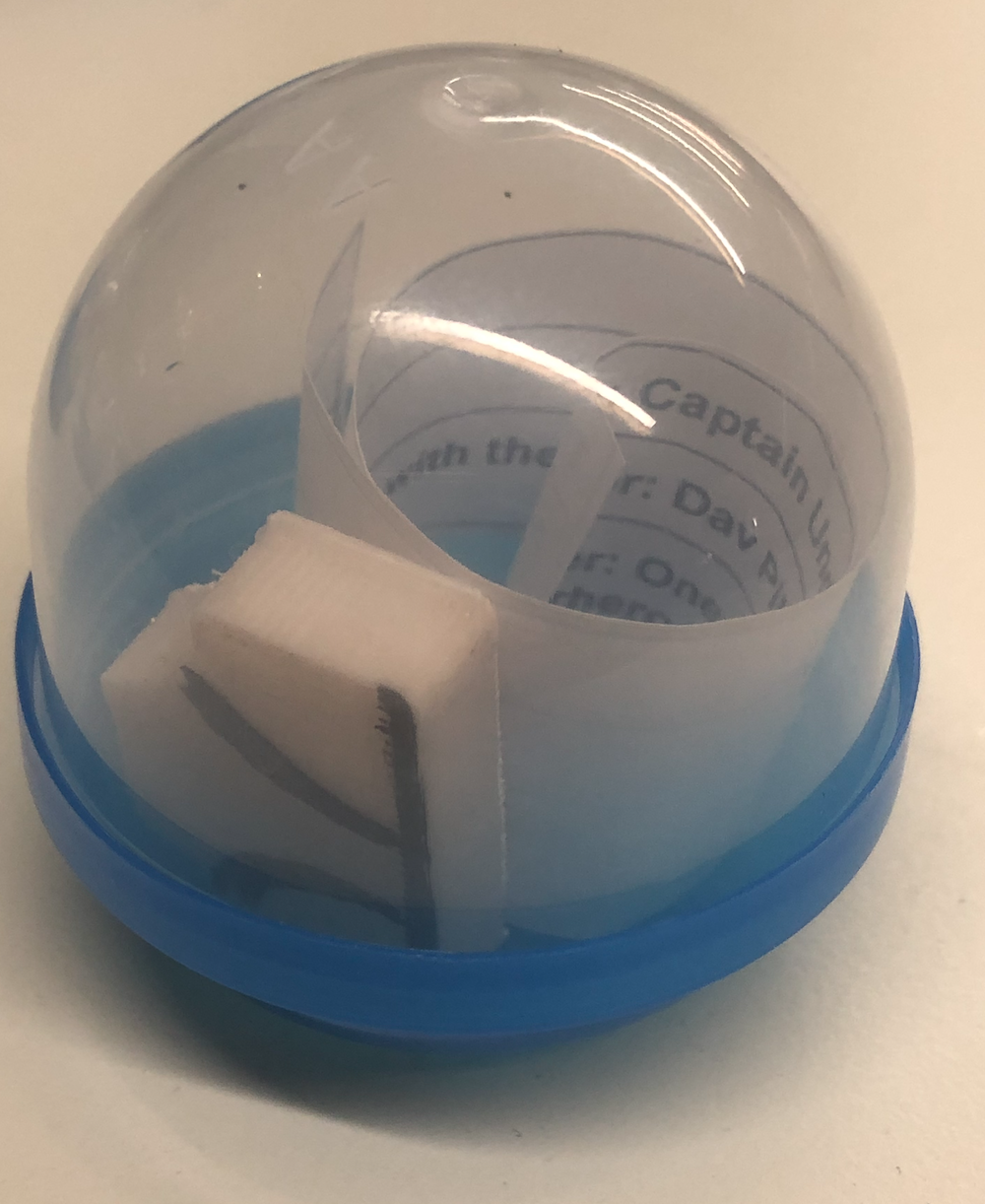
Students then wrote out a description of the book and then crafted a two to three sentence teaser about the story to get a third grader excited to read the book, the thought of it like a short commercial. We shared an assignment through Google Classroom with a template for the book slips that would go in the acorn containers. Students included the title, author and call number of the book. We did some editing and revisions on the teaser slips and the students were ready to move to the next step of the project.

Next came the challenge, fourth graders needed to design an object that was connected to the book. They sketched out their ideas and planned their designs. Some designs included beanstalk from the Land of Stories, a hamburger from Stick Dog, and more.

Then we did a refresher tutorial on how to use Tinkercad, our online 3D design software. Students worked on using the shapes and items in the software library to build and make their designs. We also focused on measurements. Students measured their designs using the tools in the software and then measured the acorn containers that their objects would need to fit into. Then fourth graders started designing and working on their 3D objects. They were creative using the shapes in the library and then adjusting and re-adjusting their objects to make sure their measurements were correct. After the designs were completed, students uploaded their files to the library website to be 3D printed.


Next came the test, did their prints come out the way they wanted and could they fit into the vending machine acorns? Some prints worked, some were too small and some were too big, others had to make adjustments to parts or pieces of their designs. Back to the design process and another iteration of their 3D prints, students made adjustments to their 3D files, resubmitted them and printed the designs.

Once the prints were the correct size and design the fourth graders wanted, they added color details to their designs with markers, printed out their book commercial slips and assembled their vending machine acorns.


The book recommendations and 3D printed objects were added to the library book recommendation machine ready to spread the word about some awesome books for third graders. The project was a great success, fourth graders were thoughtful about their book recommendations and spent time learning more about the 3D design process. They also went through the iterative process, printing out their designs and making changes if the print did not work. Fourth graders learned that design is a process and it might not be successful the first time. It has also been wonderful to see the third graders so excited about the machine, looking at the book recommendation and making a connection with the 3D print and learning about some new books.


Wednesday, June 23, 2021

First Graders learn and work together to build a healthy city ecosystem!

This school year has been challenging for so many reasons. With the global pandemic there has been remote learning, hybrid learning and in person learning with precautions like students six feet apart, masked and no shared materials. It has been a challenge to design projects that are hands-on and collaborative for students with all of the restrictions. The first graders study the idea of community, their school and neighborhood communities and our Chicago city community. The Covid pandemic has also brought to our attention the inequity in our cities, towns and communities.

I spent time thinking and planning a project that would connect with the study of community. I also wanted to incorporate some hands-on building and a way for students to be collaborative. As I started to think about the last year and make connections with the topic of communities and think about the designing and redesigning process, the idea of rethinking our city and community started to form and this reminded me of a wonderful picture book biography I had purchased for the school library a few years back, Walking in the City With Jane: The Story of Jane Jacobs. Jacobs poses the question “What does a city need to be a healthy ecosystem?” This was the big question first graders tackled for this project!


Students started with reading the book Walking In the City With Jane: The Story of Jane Jacobs  by Susan Huges. The story shares the life of Jane Jacobs, an urban thinker and activist. Jacobs believed that cities were amazing places to live and that they should be ecosystems designed for all people. Students talked about what the parts of an ecosystem are, the living and nonliving things. Then in small groups students explored other books including The Curious Garden about the Highline in New York and the 606 in Chicago. Some groups read the book The Secret Subway, the story of the origins of the NYC subway system. Students made connections with the idea that building a train underground was originally thought to be an impossible idea and that sometimes ideas that seem impossible end up being ideas that work. Students also explored books about bridges around the world, free little libraries, wind and solar energy and water systems in cities. Throughout this process students collected information and ideas about what were essential parts of a healthy ecosystem, they were “actively contributing to group discussions” (Learner III D.1) as well as “developing new understanding through engagement in a learning group” (Learner III A.3.)

Next, first graders worked together to think about how they could reimagine and rebuild the city of Chicago as a healthy urban ecosystem. They started by brainstorming what is needed in a healthy city for every person living there to be healthy, happy and safe. Students shared ideas about housing, transportation, water, green spaces, food, stores, places to work, exercise and entertainment spaces. They also talked about how to use green energy like solar panels and wind energy to take better care of the earth. First graders brainstormed ways to make sure everyone has a place to live, food to eat and transportation. We used Jamboard to collect student ideas and connections, using this collaborative tool allowed students to see each other's ideas, make connections and build on them to come up with an extensive list of ideas on how to build a better future city of Chicago. This was a way of “establishing connections with other learners to build on their prior knowledge” with these new ideas students were able to add to their understanding and their design plans “creating new knowledge” (Learner III B.2.)


Then first graders were given the challenge to design and build their neighborhood in the future of the city of Chicago. Students drew out plans for their neighborhood ecosystem. With their ideas down on paper, first graders were ready to start prototyping their neighborhood ecosystems. The library team put together a maker cart full of building materials including different cardboard shapes with connectors to make buildings and structures, pipe cleaners, puff balls, different colored construction paper and tissue paper, feathers, foam shapes, and more. First graders started building! They built roads and waterways, future transportation systems, gardens on top of buildings, amazing playgrounds and houses, farmers markets and robots that deliver food to everyone. Students were creative in the materials they used and the designs they created. First Graders also worked with classmates to connect their neighborhoods together.


Finally, first graders made videos explaining their neighborhoods, what they built and why their designs were a healthy, happy and safe ecosystem for everyone. All of the neighborhoods were placed together in the library to create a giant 1st grade prototype of the future City of Chicago, a website was created to share the videos, photos and the project and a bulletin board was created outside the first grade classrooms. Students were so creative and thoughtful as they designed a space that is a wonderful future ecosystem for our city. Throughout this project students used a variety of resources including books, web searches, online databases and each other to learn more about healthy city ecosystems. They designed and then built their prototypes using a variety of materials to make their ideas and designs come to life. Finally they recorded videos and images to contribute to a collaborative website to share their projects with the whole community. Through this project the school library “modeled the use of a variety of communication tools and resources” (School Libraries III B.1.) Also giving students the opportunities to brainstorm, share ideas, talk about their designs and share, the school library illustrated how to “cultivate networks that allow learners to build on their own prior knowledge and create new knowledge” (School Library III B.2.)


Monday, November 9, 2020

3rd Graders’ Excellent Adventure to the Ice Age: A Mashup of Research, 3D Design and Virtual Reality

 The end of the 19-20 school year and the beginning of 20-21


The last year has been so challenging. Starting in March my school went to full remote. Trying to limit screen time and thinking about social emotional needs of students and families, the decision was made to limit some of the classes including library and technology live teaching. I tried to make connections with teachers and students through videos and building and making project ideas for students to do at home as well as trying to make connections with what students’ home life might be like, suggesting walks and neighborhood scavenger hunts. We made it through the remainder of the school year. 


The summer was filled with anxiety and uncertainty about what it would look like if we were able to return to school in person or how to start the school year if we were not. My school made the decision in August to return in person but with strict social distancing guidelines. Classes would be split into two pods, each pod with a max 10 students, students would be in their desks spaced six feet apart, no shared materials or resources could be used. All of these limits presented so many challenges, especially for a teacher who focuses so much on collaboration, building and making. How could I make connections with teachers, curriculum and have students connect with each other and their work with all of these restrictions placed on how we could teach and students could learn? 


We are now moving into month three of the school year and it has not been perfect or even easy, it is not a way that I would choose to teach or work with students but we are surviving and I think the students are doing some really wonderful things, learning in different ways and we are still finding ways to allow for students to be creative and build.


Collaboration with Third Grade Teachers 


This year I am rotating between grades every three weeks to limit cross-contamination. Each week for three week I have three sessions with each pod. When it came time to work with my third graders, I wanted to do a project that connected something they were learning in their classroom with research and building, something we would have done in a normal school year. The building would need to be in a digital format or space because we would not be able to use all the materials and resources in our makerspace. I connected with the classroom teachers to find out what topics they were working on in their classrooms and thinking about possible projects to do with students. The third graders were learning about the Ice Age and what the area of Chicago and Illinois was like hundreds of thousands of years ago and how the land we live on, Lake Michigan and our space was formed. What if students learned about the environment and then had to design a time machine that would be able to travel around the Ice Age to document the Chicago of the past? And what if they had to create the Ice Age world as well? Third Graders’ Excellent Adventure to the Ice Age! (Collaborate School Library III.A.2 “Leading inquiry-based learning opportunities that enhance the information, media, visual, and technical literacies of all members of the school community.)


Research and Understanding: The Ice Age


Students were engaging with research and discussion about the Ice Age in their classroom work. In their library time I was going to continue to have them research about the Ice Age using the library’s online research resources. I created a Google slide deck with videos and links to National Geographic, Encyclopedia Britannica, and BrainPop. The slides had sections that students could edit to add their notes. The prompt that I gave students was to think about what the environment was like in the Ice Age, what animals lived during that time and what did they learn about the formation of Lake Michigan. Students spent time reading and listening to the articles, watching the videos and collecting their notes and information. They asked more questions about more types of animals that lived during the Ice Age and we did some whole class research to learn more about the animals and the distant cousins that still live today. (Collaborate Learner III.B.1”Using a variety of communication tools and resources.)


The Building Challenge: A Time Machine!


One thing that I always try to include in projects that I do with students is a building or making project with the research and information that they learned about, it is not just about collecting information, what is something new that you are going to make with that information. The challenge for third graders: based on what you learned about the environment of the Ice Age and the animals that lived at the time, design and build a time machine that could travel back to the Ice Age, travel around the world, and collect pictures and videos of the time period. (Collaborate Learner III.A.2 “Demonstrating their desire to broaden and deepen understandings.)


Students started sketching out their designs thinking about the land of the Ice Age. They took into account the glaciers, snow and ice, and changing format of the land as glaciers retreated and the Great Lakes were formed, as well as the animals they might encounter and the extreme cold of the time period. Next, I introduced how they were going to make their time machine, with the 3D design program Tinkercad. Tinkercad is an awesome online and app 3D design program that is great to use with students to make and create in 3D. Tinkercad can be a challenging app to work with and students need to think about shapes and space to design their projects. Third graders spent time looking at their design plans and thinking about how they could take the shapes and tools in Tinkercad and create their time machines. Even though students were at their individual desks and not able to work collaboratively, they still found ways to help each other. When a student was unsure how to make something or what shape to use, they mirrored their work up on the screen in the classroom and other students offered suggestions and ideas on how to make it work. Students were so creative with their designs and ideas, they built their machines to have space for the time travelers to collect samples, store supplies and clear roofs to observe the world around them. Their designs included unique ways to travel around the Ice Age including flying, giant tires to travel over ice and machines that could also go in water. (Collaborate Learner III.B.1”Using a variety of communication tools and resources.)


Challenge Part 2: An Excellent Ice Age Adventure! 


Now that students had their time machines, they needed to travel to the Ice Age. The next step was students recreating the Ice Age using the virtual and augmented reality website and app CoSpaces Edu. CoSpaces Edu is a great tool to use to introduce students to AR/VR applications and creation. In the site students are able to choose a 3D world, add objects and items from the CoSpaces library as well as upload 3D designs, images and videos. Another feature allows users to code items from the CoSpaces library to move, animate and talk. Students are able to use block code to add all these features to their worlds. Third graders were able to learn how to create in a new format with the AR/VR tools and continue to build on their coding skills using the block coding in the CoSpaces platform.


Third graders were given guidelines on what their worlds could include, they had to make sure it was accurate as possible. Students referred to their Ice Age research to think about what animals might be in their Ice Age world, water and what plants might be similar to what existed during the Ice Age. As students were adding 3D objects to their world, we talked about what animals might have been similar including the woolly rhino, a distant cousin of the deer, and the Giant Ground Sloth. We talked about how none of the people available in the CoSpaces library really fit in the world, but agreed that having the astronauts in the CoSpaces library could represent the time travelers to the Ice Age. (Collaborate Learner III.B.1”Using a variety of communication tools and resources.)


The third graders worked so hard to learn this new technology, they figured out how to design their worlds, offer help to their fellow classmates in their designs, and do more research to make sure what they were creating was as accurate as they could be with the tools available. Once everyone was done with their worlds, students had an opportunity to explore the Ice Ages of their classmates and the rest of the students in third grade. It was wonderful to see them offer compliments and ask their fellow classmates how they coded their items or designed their time machines. (Collaborate Leaner III.D.2 “Recognizing learning as a social responsibility.)


Overall this project was a great success. Students did a great job navigating research resources and recognizing when they needed new information as they were building their worlds and returned to do more research to complete their projects. They were beginning to understand that research is an ongoing process, a skill and mindset that I hope to continue to develop. Third graders also learned a new design tool in Tinkercad. The 3D design process can be frustrating and the students handled managing their struggles and finding a way to complete the project. They were also creative and embraced the challenge of learning how to design and build their own worlds in virtual reality. Students also continued to build their coding skills, taking the block coding they had learned in earlier years and learned new coding techniques and blocks in the CoSpaces platform. It was also wonderful to see students explore their fellow classmates’ world and give feedback and compliments on their work.


Tuesday, February 25, 2020

Kindergarten: Coding, MakeyMakey and a Field Trip around the Solar System

My kindergarten schedule is hard. I only see the students once a week for thirty minutes and that includes time for checkout. A couple of years ago we created something called Library Flex days in order to have some more time to do in-depth projects with the students. How flex works is each of the three kindergarten classes have a four week time when half the class comes on Monday afternoons for thirty minutes and the second half of the class comes on Wednesday afternoon. This allows us to do more hands on projects because of the smaller class size and gives me more time with the students to explore topics that they are interested in. Before each flex session I talked to the classroom teachers about what topics the students are interested in, what have they been exploring in the classroom and what areas to they think the students would love to explore more. Over the years we have done some fun projects about mazes, dinosaurs, clouds, coral reefs, peace and monarch butterflies. Flex time is a way to lead “inquiry-based learning opportunities that enhance the information, media, visual, and technical literacies of all members of the school community” (School Library III.A.2). This year one of the kindergarten classes is really into space. They did a huge project in their classroom about the moon, the moon landing and astronauts. In their library flex time we continued exploration of space by studying the planets in our solar system.

We started the project time with research and reading about the different planets in the solar system. We read the book “If Pluto was a Pea” by Gabrielle Prendergast. I really like this nonfiction book because it focuses on the different planets in the solar system and how much they vary in size. The book compares the planets to different objects that students will be familiar with, like Pluto is a pea and Jupiter is a beach ball. This helped the students to make connections with the significant differences in the planets. Next we used the library’s Merge Cubes to explore the solar system using augmented reality. The Merge cube is a really cool device that when you view it through an app on the ipad the objects pop out. SKers explored the solar system AR app with the Merge cube to learn more about the where planets are located in the solar system and how they all rotate around the sun. The solar system AR app also has information boxes to share facts about each of the planets. AR and the Merge Cube are new tools to share with learners and “[models] the use of a variety of communication tools and resources” (School Librarian III.B.1) by highlighting a new technology as a resource for finding information.

Students continued their research during the next session using the library’s PebbleGo database. PebbleGo is a research resource for younger students and is a wonderful entry point for online research.PebbleGo also has a ‘read to me’ function that allows younger students to be more independent information seekers.  SKers worked in small groups to research different planets and collect notes on their topic. Working in small groups to collect and discuss information is a way for learners to “[develop] new understandings through engagement in a learning group” (Learner III.A.2), students listened to the facts, talked to each other about what they learned and decided as a group what information was important to document.

The next session focused on building the planets! Students looked at their research and explored images of their planets and then worked together to build the planets using round paper lanterns and tissue paper. They also used pipe cleaners to add rings and foam balls and wire to include the moons for the different planets. The sun group learned about the solar flares on the giant star and used lots of tissue paper to add flare! The learners were focused on “establishing connections with other learners to build on their own prior knowledge and create new knowledge,”(Learner III.B.2) kindergarteners worked together to make connections with the research they had done and then collaborate to create their own models of the planets that reflected their understanding.

The final step was creating an interactive map with MakeyMakey and Scratch coding! The map was created based on a Instructables project shared by Makerspace Librarian Colleen Graves. I follow Colleen on twitter and have gotten so many ideas and so much inspiration from her. Twitter can be a wonderful professional development resource for librarians! Sharing that ideas were sparked from social media interactions is a great way to “[demonstrate and reinforce] that information is a shared resource.” (School Library III.D.2)

The map included conductive tape, wires, MakeyMakey and students holding hands to complete the circuit to make music and voice recordings play. We created the map using the instructions from Graves and made adjustments to create a path that followed the order of the planets from farthest to closest to the sun. Next students recorded facts they learned about the planets and the recordings were uploaded to Scratch coding and connected to the different inputs on the MakeyMakey. When two students walked on the conductive tape while holding hands space inspired music played, at each planet there is a copper footprint, the student on the yellow path stepped off the conductive tape onto the copper footprint, this triggered the input to play the voice recording sharing facts that students recorded about each planet. All of the planets were put in place on the map, the wires connected, the sun hung up and the final touch the Colonel Francis W. Parker, the founder of our school, put on a spacesuit, ready to explore the solar system!


The students were ready to share! The final day students paired up to explore the solar system map they created, walking the path and completing the circuits to learn more about the solar system. While groups were exploring the interactive map, other students used the library’s virtual reality Google Expeditions goggles to explore the solar system in an immersive 3D field trip. It was a great trip to outer space! The interactive map is up in the library so students can bring their families to share and students in other grades can see this cool project.


This project was so much fun for the students and for me! I loved trying out a new project inspired by my twitter PLN, learning some new tech tools and skills when I was building the interactive map and being able to share this project with students and the larger school community. My students learned so much about the solar system, used some really cool research and building tools and worked together on a really, really amazing visible interactive map.

Tuesday, February 18, 2020

Junior Kindergarten: fairy tales, non-fiction, & collaboration

During the junior kindergarten (preschool) classes in the library one of the focuses is on early literacy and understanding elements of a story. In the past, I have read different fairy tale stories that the student might be familiar with, Red Riding Hood, 3 Little Pigs, etc, and then talked about the beginning, middle and end of the story, as well as the characters and the setting. This year, I was thinking of making some more connections with some of the other resources in the library and with a student building project. My students have been asking to do a building project for a couple of weeks. I planned a project that included fairy tales, building the setting and nonfiction research with the library’s PebbleGo database and all ending with a dramatic robot retelling of the stories!

The project started with each of the three classes reading a different version of a fairy tale. The first class was the “Three Little Gators” by Helen Ketteman. I started the lesson by asking students if they have heard the story of the three little pigs. They started sharing the story, most remembered all the elements. I then introduced the three little gators, I showed them the cover and asked what they thought would be the same as the three little pigs. Students shared that the gators were the same as the pigs and they predicted that the gators would build houses. Then I asked what they thought the setting of the story was, I explained that the setting was the background, where the story took place. I asked if anyone knew where gators lived, several students said a swamp and then made the connection that the setting of this story would be in a swamp. Before I started the story I asked students to think about what happens in the beginning, middle and the end of the story and to also think about who the characters are in the story. We read the very funny story and then I documented what the junior kindergarteners said about the events that happened in the different parts of the story and the main characters of the three gators and the big bottomed boor.


I followed the same discussion and process for the next two classes. I have all three of my junior kindergarten (JK)  classes in a row on the same day. The next class read the story “Pretty Salma” by Niki Daly, a retelling of Little Red Riding Hood set in the grasslands in South Africa and the final class read “The Three Snow Bears” by Jan Brett, a Goldilocks story set in the arctic. This process focused on students making deeper connections with stories they had heard before and seeing the similarities and differences in different versions in the story. This is a way for students to “demonstrate their desire to broaden and deepen understandings” (Learner III.A.1).

The next library session, students started with sharing what they remember about the beginning, middle and end of the story, the characters and the setting. I told the JKers that we would be learning more about the setting of our stories. We used a great online database we subscribe to PebbleGo. PebbleGo is a great introduction to online resources for students. The interface is very accessible, the layout of the articles are easy to navigate and the information is presented in digestible bites for young students. PebbleGo also has a “read to me” function making it a great resource for students to navigate independently. Students were divided up into small groups and worked with a teacher to listen to the article about the setting of their stories, wetlands, grasslands and tundra. As the students listened to the articles, the teachers collected the facts students learned about the ecosystem. We also looked at images of the different areas and students documented what they saw in the pictures, what they noticed about the trees, ground, the water, etc. I explained to the students that this research was going to be important for the building project. This was a way for students to “use a variety of communication tools and resources” (Learner III.B.1), junior kindergarteners made connections with the images in the book, facts from PebbleGo and pictures of the ecosystems to find the information they needed to be able to build their own settings.

Building was the next session. Students were reminded about the story we read and the research they did on the ecosystem where the book was set. The junior kindergarteners were put into small groups of about five students. Each group was given a large section of cardboard to build on and at each table there was a collection of different materials to build wetlands, grasslands and a tundra. For the wetlands there was lots of green moss, rocks, blue table clothes for water, different green papers and small plastic animals including snakes and alligators. The grasslands had lots of different types of grasses and rocks, orange, yellow papers and zebras and giraffes. The tundra had white paper and boxes, blue paper for water and white foam craft balls to build snow drifts, as well as penguins and polar bears. Students worked together to plan out their space, make connections with what they learned about the different ecosystems and use the materials in creative ways to build the settings for the stories. During this part of the project, junior kindergarteners “established connections with other learners to build on their own prior knowledge and create new knowledge” (Learner III.B.2). Students talked and collaborated with each other to use the different materials to build their setting based on what they learned about the setting and ecosystem and making connections with classmates’ understanding about the ecosystem. They were also “actively contributing to group discussions” (Learner III.D.1). Throughout the building process junior kindergarteners were talking to each other, making decisions about what materials to use and how to build with them, they discussed and negotiated how to collaborate on their setting.

The final library session for this project was the dramatic robot retelling! We set all the boards created by the junior kindergarteners in a row. Students all sat on one side of the boards. We decorated some of the library’s Dash robots with pictures of the characters. Then we shared a whole class dramatic retelling of the stories, the robots moved around the setting that JKers built, while students chimed in at different points to share the beginning, middle and end of the story.


This project was a big hit. It was a great way to combine early literacy skills to help students understand story structures, introduce online databases and nonfiction. This was also a way for students to engage in creative building. They were given the opportunity to take a variety of materials and creatively use them to make build the setting for the books based on their fiction and nonfiction research. Students also collaborated during the whole school discussion, small group research and small group building. The whole project ended with a fun way to add the robots into another project with junior kindergarteners.